PIANO CASA: Building Methods, Not Just Homes
The Housing Plan should not merely fund construction sites.
It should build a new supply chain for living.
This may well be the real stake of Italy’s Housing Plan: not only making resources available, but understanding what design, production and administrative capacity we are able to activate around those resources.
Because housing is not a budget line.
It is an industrial, urban and social policy.
The risk today is that the Housing Plan is interpreted as a new season of isolated interventions: maintenance works, energy upgrades, building refurbishments, individual construction sites. Necessary actions, certainly. But not sufficient, unless they become part of a broader process capable of producing knowledge, standards, quality and replicability.
The project for Maffeo Bagarotti, developed by ARW Associates in the Baggio district of Milan, was born precisely within this question.
How can an inhabited public building be regenerated without reducing it to a technical object?
How can energy performance be improved without losing architectural quality?
How can we work on an irregular, stratified and complex building stock without forcing it into standardized solutions?
How can we move from a single intervention to a replicable method?
Maffeo Bagarotti concerns a public housing complex from the 1960s and 1970s: a fragment of the city built to respond to a housing emergency, now called upon to address new demands for comfort, safety, accessibility, maintenance, energy performance and urban relationships.
It is not an isolated case. It is a widespread condition.
Much of Italy’s public residential heritage is now in this intermediate state: still inhabited, still necessary, but no longer adequate to the climatic, social and technical conditions of the present. Energy-intensive buildings, weak shared spaces, residual ground floors, obsolete envelopes, complex maintenance, neighbourhoods that call not only for repair, but for care.
This is why the question cannot simply be “to renovate”.
The question is how to renovate.
The Maffeo Bagarotti project was developed within the framework promoted by Edera with Energiesprong Milano, which created a shared field of work between public administration, designers, social expertise, engineers and the production supply chain.
The value of this process lies not only in having addressed the issue of energy efficiency, but in having broadened it: construction times, continuity of living during the works, quality of shared spaces, desirability of buildings, economic sustainability, measurable performance and replicability.
In this sense, Energiesprong is not simply a technology or an operational model. It is a question addressed to the construction sector: are we able to make deep retrofit faster, more accessible, scalable and, at the same time, more architecturally and socially qualified?
For us, the answer comes down to one word: method.
At Maffeo Bagarotti, we worked on a strategy we summarise as OFF > ON: moving off site what can be industrialised, while keeping on site what requires adaptation, precision and knowledge of the existing condition.
It is a design position before it is a technical one.
Italy’s building stock cannot be transformed with the tools of the last century, but nor can it be handed over to blind prefabrication. It is too irregular, too inhabited, too specific. What is needed is a hybrid path: industrial precision and architectural intelligence; replicable components and contextual adaptation; construction speed and urban quality.
From this perspective, the dialogue with the production supply chain — in particular with the expertise of Manni Group / Isopan — was decisive.
Not as a simple product supply, but as a reality check for the project.
The issue was not to choose a panel or apply a ready-made solution. The issue was to study together which systems could truly be compatible with an existing, inhabited, irregular and complex building: dry façade systems, prefabricated components, window details, systems integration, installation times, maintenance, tolerances and adaptability to real geometries.
It is through this close dialogue between design and production that retrofit changes scale.
The supply chain does not enter at the end of the process to provide a component. It becomes part of the strategy itself, helping to understand what can be industrialised, what must remain adaptive, and which conditions make it possible to move from prototype to repeatability.
For ARW, Maffeo Bagarotti is also this: a testing ground for the relationship between architecture and industry, where production excellence does not replace design, but forces it to become more precise, more measurable and more concrete.
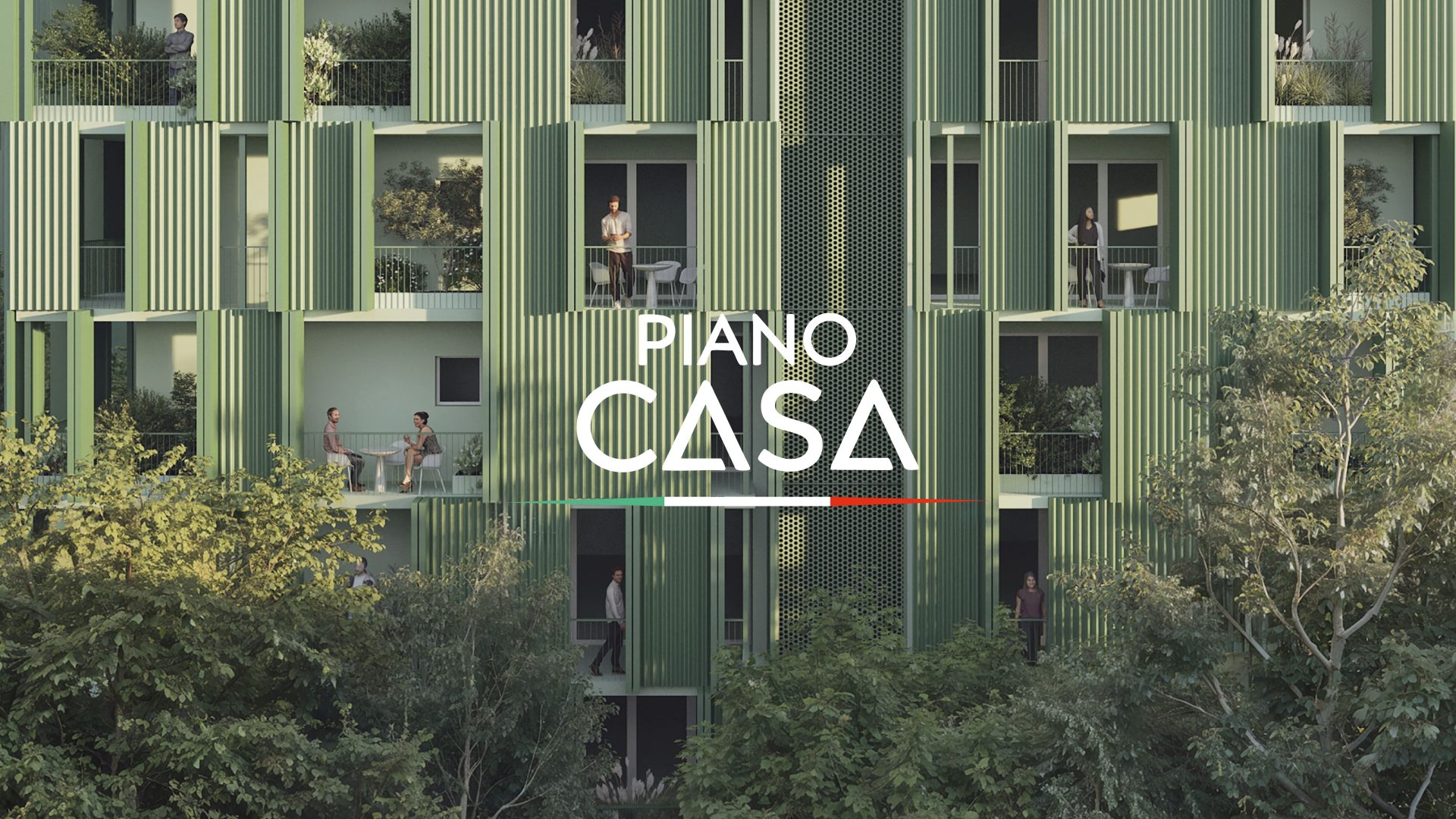
The proposal works across six areas: outdoor spaces, ground floor, façades, housing units, building systems and structure, roof.
The ground floor is not treated as a technical back-of-house, but as an urban threshold.
The façade is not a cladding, but a new energy and architectural infrastructure.
The loggias are not accessories, but extensions of living.
The roof is not a residual space, but a technical and environmental platform.
Maintenance is not a future emergency, but a condition to be designed from the outset.
The goal is not to “add insulation”.
It is to build an ecosystem capable of reducing consumption, improving the life cycle of materials, simplifying management and producing concrete, measurable performance over time.
Here, Maffeo Bagarotti tries to shift the discussion from “how much” to “how”.
Not only how many homes we make available.
But what living conditions we make possible.
Not only energy efficiency.
But habitability, comfort, safety, maintenance, identity.
Not only building interventions.
But supply chains capable of producing quality at scale.
This may be where the Housing Plan should look more closely: at the ability to build collaborative processes between the public sector, design and production. Because without a mature supply chain, even available resources risk being dispersed into a sum of isolated construction sites.
Public housing cannot be treated merely as a heritage to be maintained.
It is a heritage to be reactivated.
And the real innovation of the Housing Plan could begin here: not by funding only works, but by building methods.
Methods that can be learned, improved and replicated.
Methods capable of holding energy and urban quality together.
Methods capable of transforming existing buildings into new infrastructures for living.
Because living does not simply mean having a home.
It means living in more efficient buildings, more cared-for shared spaces, more legible neighbourhoods and fairer cities.
Housing, before being a private asset, is a public matter.