CAMBIARE SENSO: Three urban arteries reclaimed for the city
Piazza Vittoria was once a car park. So was Piazza del Mercato. Cars even occupied Piazza del Duomo. And until just a few years ago, traffic still passed through Piazzale Arnaldo.
Today, we take it for granted that these places are spaces for people to meet, rather than places to park or drive through.
But it wasn’t always this way.
At some point, someone began to imagine a different kind of city. To ask whether the space occupied by cars could be given back to people.
It wasn’t just the physical form of these squares that changed. First, the way we thought about them had to change.
What if we asked ourselves the same question about our streets today?
What if a street could become a city again?
For decades, we have measured the efficiency of streets by their ability to keep cars moving.
Cambiare senso starts with a different question: how much space could we reclaim for urban life if we stopped treating private vehicles as the starting point for urban design?
In Brescia, three major streets in the historic city centre become the testing ground for a shared urban strategy: Via San Faustino, Via Gramsci and Corso Martiri della Libertà.
Three different streets, three distinct identities, one common principle: redistributing existing space to give it back to people, nature and public life.
The project goes beyond mobility. It rethinks the very role of the street in the contemporary city.
Stop designing lanes. Start designing cities.
Cambiare senso is, first and foremost, about changing our starting point.
If we start with cars, we design lanes, traffic flows and parking spaces. If we start with people and nature, streets can become public spaces again.
Traffic doesn’t disappear, but it no longer determines the shape of the city on its own.
Roadways are narrowed, pedestrian space expands, greenery becomes an integral part of street infrastructure, and new places emerge where people can stop, meet, play, sit or simply slow down.
The question is no longer just “How do we get through this street?” but “What would make us want to stay?”
It marks a shift from a city designed primarily for movement to one designed for people to spend time in.
Three streets. Three ways to reclaim urban space.
VIA SAN FAUSTINO: The Green River
Via San Faustino is currently a contested space. Cars dominate the roadway, disorderly parking frequently spills onto its edges, and pedestrians are sometimes forced to walk in the street. Pedestrians, cyclists and drivers compete for insufficient space amid traffic, noise and uncontrolled parking. One of the most important connections in the historic centre has become, above all, somewhere to pass through as quickly as possible.
Yet Via San Faustino connects the metro, the University, the Carmine neighbourhood, Piazza della Loggia and, in the future, the new lift to the Castle, currently under construction. It has the potential to become a civic backbone, rather than simply a traffic corridor.
The project reverses this condition: it introduces a limited-traffic zone (ZTL) and reduces the roadway to a single traffic lane, freeing up space for walking, cycling and spending time.
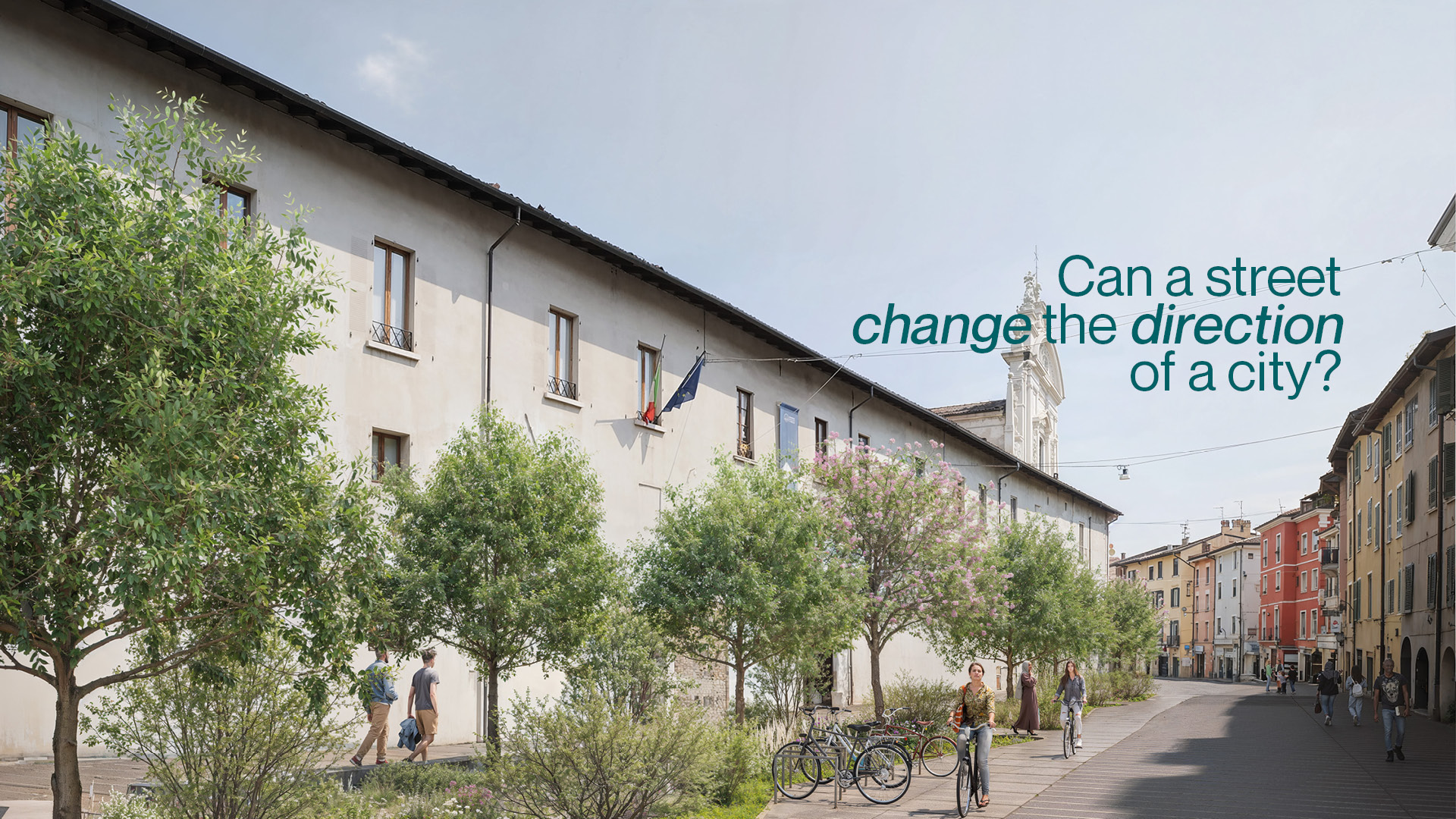
The street becomes an urban linear park, a slow, shaded promenade where mobility, greenery and social life coexist.
A continuous green corridor runs along the street, recalling the waterways that once flowed beneath San Faustino. Not a garden added to the street, but a “green river” that widens and narrows, creating a sequence of public spaces along its course.
Greenery becomes climate infrastructure: providing shade, increasing soil permeability, helping to reduce urban heat and giving the street a new identity. Rain gardens, planted depressions designed to collect, filter and allow rainwater to infiltrate the ground, introduce a new approach to stormwater management.
Along the route, small squares, university spaces, seating areas, playgrounds, event spaces and shaded places create new opportunities for public life.
Not just a place to pass through, but a place to stay.
VIA GRAMSCI: The Golden Gateway
Via Gramsci offers one of the most remarkable urban perspectives in central Brescia: the street opens directly onto Piazza Vittoria.
Yet today, this relationship is almost erased by traffic.
Cars dominate the scene, the two sides of the street barely interact, and one of the most significant entrances to the heart of the city is perceived primarily as a traffic corridor.
The project transforms Via Gramsci into an urban gateway: a monumental entrance conceived in dialogue with the scale and twentieth-century architectural character of Piazza Vittoria.
Removing one traffic lane creates more pedestrian space and reconnects both sides of the street with the square. A sequence of Ginkgo biloba trees defines the new entrance. In autumn, their foliage turns golden, transforming the streetscape into a distinctive gateway that draws the eye towards Piazza Vittoria.
The aim is not to invent a new identity for Via Gramsci.
It is to allow the identity that already exists to become visible again.
CORSO MARTIRI DELLA LIBERTÀ: Living the Street
On Corso Martiri, the problem is even more apparent: traffic lanes and parking have gradually taken over most of the available space, pushing pedestrians to the margins.
The project reverses this hierarchy.
Rather than treating the street simply as a space to move through, it reimagines it as a place to inhabit.
Reorganising mobility makes room for new pedestrian spaces, green areas and places for social interaction.
Pedestrians are no longer left with whatever space remains at the edges of the roadway.
They become the starting point for designing the street itself.
Nature is not decoration. It is infrastructure.
One of the central principles of Cambiare senso is to move beyond the idea of greenery as mere urban decoration.
Trees, permeable surfaces, rain gardens and planted areas become essential components of how the street functions.
On Via San Faustino, the project proposes an additional 1,988 m² of green space and 200 new trees and shrubs. Via Gramsci gains 274 m² of green space and 40 trees and shrubs. Corso Martiri introduces 1,448 m² of new green space and 100 trees and shrubs.
Together, more than 3,700 m² of additional green space and 340 new trees and shrubs are planned to transform three urban streets into a new environmental infrastructure for the historic city centre.
This is not a cosmetic intervention.
It is a fundamentally different way of thinking about urban ground.
Doing more with the city we already have
Cambiare senso is based on a simple principle:
Not necessarily building more, but making more of the space we already have.
A street can carry cars, but it can also absorb rainwater, provide shade, support biodiversity, sustain local businesses, give children somewhere to play, become an extension of a university, or host a market or public event.
The same space can serve many more purposes if we change the priorities that guide its design.
The same logic applies to materials. The project explores the possibility of reusing offcuts and waste materials from Brescia’s long tradition of stone craftsmanship, transforming them into paving, seating, drainage systems, kerbs and rain gardens. Rather than bringing in new materials, the idea is to give new life to resources the region already produces.
Brescia as an urban laboratory
Cambiare senso does not propose a fixed design model to be replicated elsewhere.
It proposes a method.
Every street has its own history, dimensions and identity. But many Italian and European cities share the same condition: vast amounts of public space shaped throughout the twentieth century around the needs of the automobile.
That space is already there.
The question is how we choose to use it in the decades ahead.
Via San Faustino, Via Gramsci and Corso Martiri offer three different but complementary answers: transforming a street into climate infrastructure, a traffic corridor into an urban gateway, and a space for movement into a place for everyday life.
This is what Cambiare senso is about.
Not simply changing the direction we travel.
Changing our idea of the city we want to move towards.