CASE AZZOLINI: Regenerating without putting life on hold
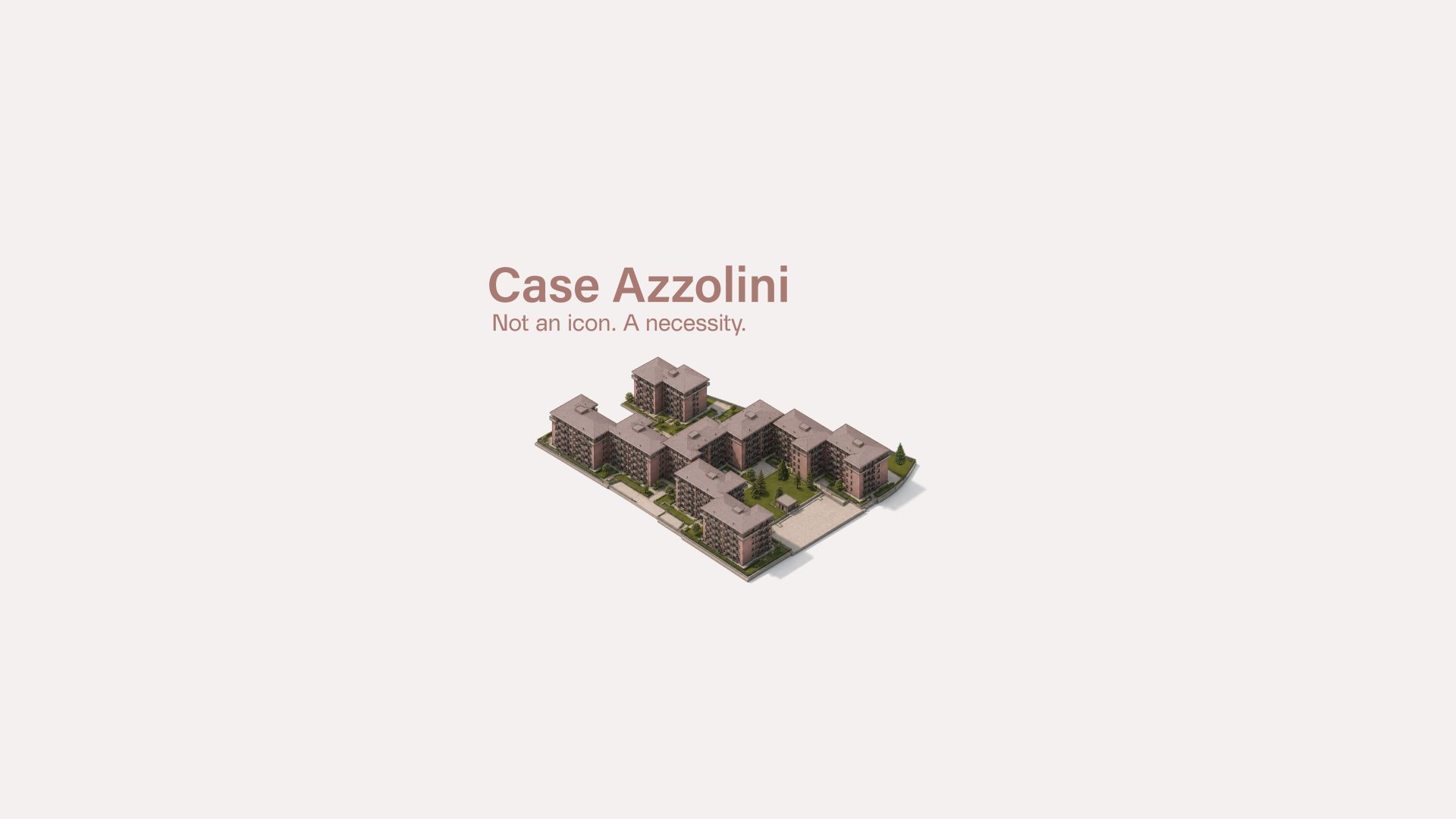
Case Azzolini, Verona. When the construction site does not wait for life to stop.
There is one thing almost no one tells you about PNRR construction sites: how many of them have actually been completed.
The PINQuA programme (the National Innovative Programme for Housing Quality) is worth €2.8 billion and includes 960 projects across Italy. As of February 2026, it was reported as “delayed”. And yet, in Verona, in the Borgo Roma district, there is a complex of five red buildings where the scaffolding has already come down.
Case Azzolini is finished.
Before: what was there
The AGEC housing complex in Borgo Roma was in “truly precarious conditions”, as Councillor Federico Benini described it. Buildings from the 1930s and 1940s that, until this intervention, had never really been properly upgraded.
One hundred families living in a place like this do not simply live with a broken window. They live with something that resembles abandonment: silent, progressive, legalised. Verona’s public housing stock, as in the rest of the country, is ageing: 53% of homes are more than 30 and less than 60 years old, while 31% are over 60 years old. Case Azzolini clearly belonged to this second category.
The PINQuA project represented AGEC’s most significant intervention: over €11 million allocated to the redevelopment of Case Azzolini in Borgo Roma. Part of the remaining funds went to Case Tombetta and to the urban regeneration of the area, with €800,000 allocated to the extension of Parco Santa Teresa and the construction of new cycle paths.
The problem was not finding the money.
It was actually using it.
The phase no one sees: the year before the construction site
In May 2023, residents were required to clear out garages and cellars and disconnect their air-conditioning systems. Almost a year later, the works had still not begun. Tenants were exasperated: they could not park their cars in the garages, they could not use their cellars, and during the hottest weeks they had no air conditioning, including several elderly residents.
This is a part of the story that does not appear in press releases. But it is the real story of the project. Because living in a construction site does not begin when the cranes arrive. It begins earlier: when you are asked to empty your basement and still do not know when it will end.
The works were handed over on 8 April 2024, after approximately one year of finalising the executive design. That year of waiting, with empty garages, inaccessible cellars and air conditioning switched off, was an integral part of the intervention. An invisible social cost that every project on occupied housing stock carries with it.
The construction site: open-heart surgery
As AGEC President Anita Viviani explained, the aim was to “renovate an entire block of 180 homes that was in extremely precarious condition, with problems of every kind”. An operation carried out “as open-heart surgery, since the homes remained occupied; with tight deadlines imposed by the PNRR; and in conditions that were not always optimal”.
This expression “open-heart surgery” is not a marketing metaphor. It is a technical and human description of what it means to intervene on an occupied building. Every construction-site decision becomes a negotiation with the everyday life of the people inside. When deteriorated plaster is being removed on the third floor, below there is someone sleeping, working, cooking.
The works included the removal of damaged façade plaster, the repair of exposed reinforcement bars, the installation of external thermal insulation panels and the first layers of finishing render. At the same time, structural works were carried out in the basement levels, garages and cellars, which had been closed for years due to rainwater infiltration.
In parallel, the intervention included the replacement of the lifts, the connection to the district heating network and the construction of a new volume for a multipurpose space serving both residents and the neighbourhood.
Thermal insulation, new windows, district heating: they sound like technical interventions. In the everyday life of 180 families, they mean lower bills, less cold in winter, windows that actually close.
The PNRR: what usually does not happen
It is worth saying clearly, without rhetoric: in the Verona area, as of October 2025, PNRR payments had been made for only 49% of the allocated funds. This means that, in most cases, the works had not yet been completed.
Case Azzolini is one of the exceptions. The construction site started in April 2024 and by September 2024 had already reached 75% completion, making it one of the largest PNRR-funded projects in the Verona area.
Completing an intervention of this scale on occupied housing stock, with all the constraints this entails, within the deadlines set by the European agenda is not routine. It is the result of a supply chain that worked: rigorous design, coordination between AGEC and the Municipality, and construction-site management with people still living inside.
That is no small thing. In a country where “PNRR” has almost become shorthand for works that never start, or that start and then stop, this is a case in which the cycle has been completed.
What remains
It is not a spectacular project. It will not win awards. It will not appear on the covers of architecture magazines.
But 180 families in Borgo Roma now have windows that insulate, cellars that no longer flood, lifts that work, and more sustainable energy bills. And a new shared space where before there was nothing.
As AGEC President Anita Viviani pointed out: “These interventions make it possible to achieve objectives that would otherwise be unattainable with internal resources alone.”
This is what it means to turn public funding into a result. Not an image of regeneration: regeneration that truly reaches people.
Perhaps this is where we should begin again to measure the value of those who design public housing stock: not by what they produce as form, but by what they are able to restore as the possibility of living better.